
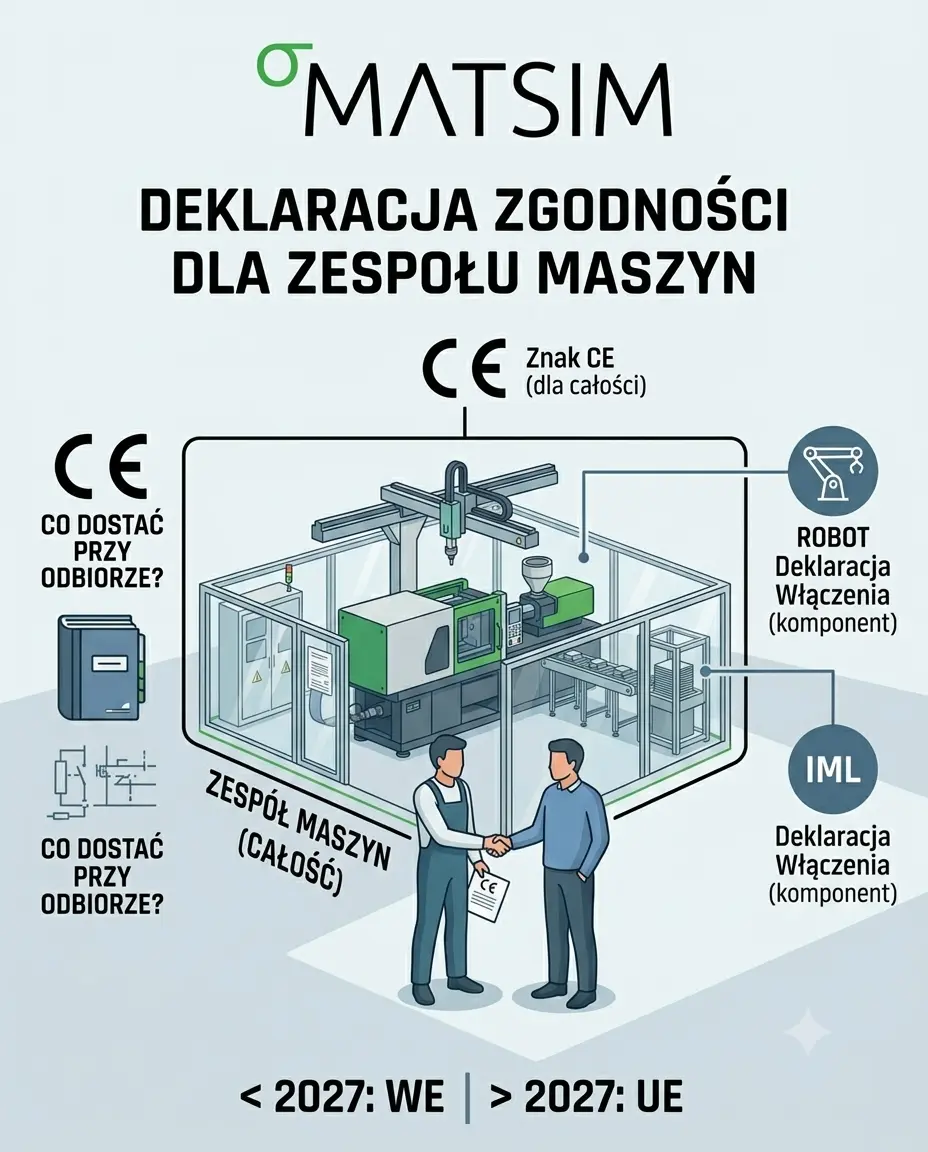
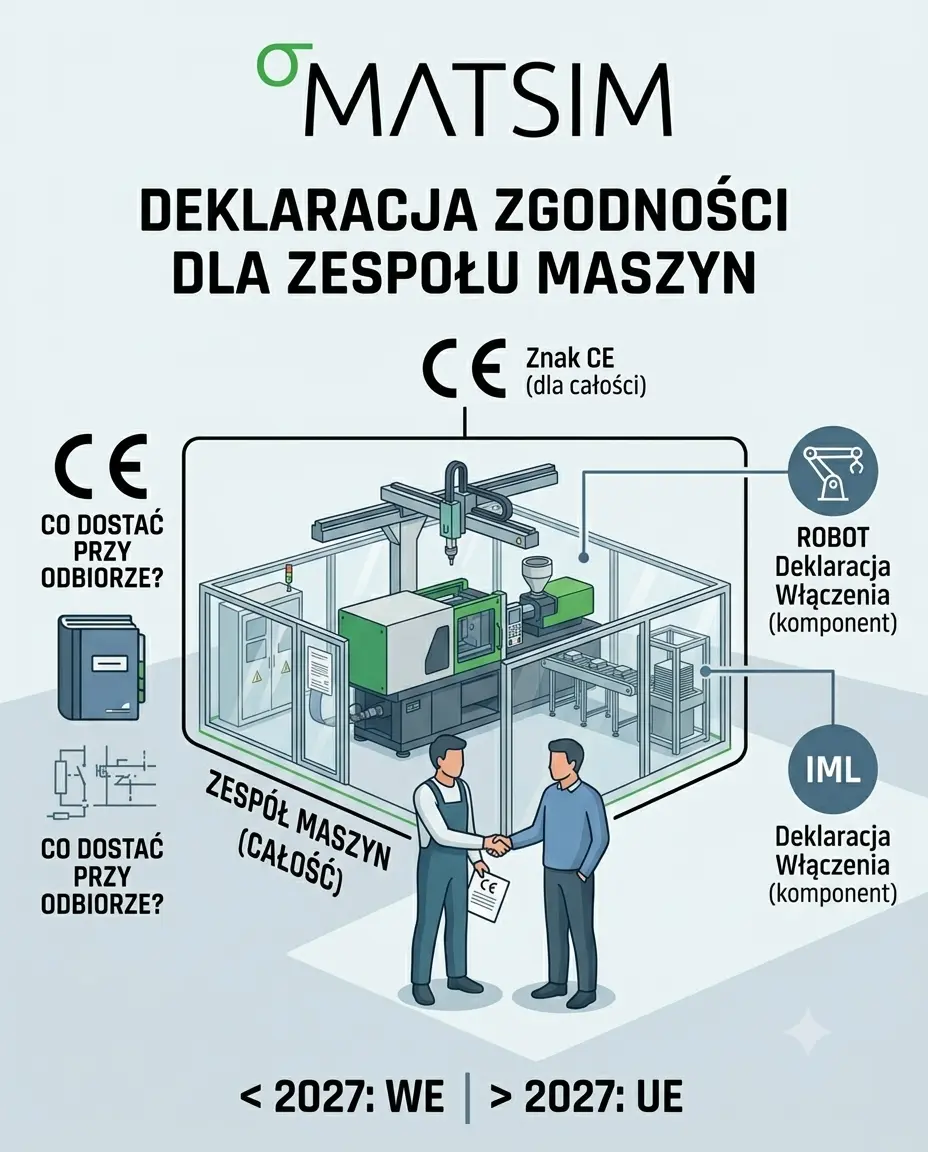
You are ordering a robotic production cell, or adding a robot to an existing injection moulding machine. Who is responsible for its compliance with the legislation? Which documents should you receive at handover? Short and to the point, in line with the new Regulation.
The integrator is the manufacturer
The legislation does not recognise the term “integrator”. If you connect several machines under a common control system, for a common production purpose, what you create is an assembly of machinery — in legal terms, a new machine. Whoever builds it is its manufacturer, with everything that follows: risk assessment, technical documentation, instructions for use, conformity assessment, CE marking and the declaration.
A typical cell in plastics processing looks like this: an injection moulding machine, a side-entry or Cartesian robot, an IML label magazine, and sometimes also a vision inspection system, a stacker and a case packer. At least three pieces of equipment from three different suppliers, shared safety guarding, an integrated control system, one production purpose — and, in the eyes of the law, one machine.
That is the starting point for everything below.
Something we frequently see people get wrong: there is no such document as a “CE Declaration of Conformity”. CE is a marking. The document is called:
- EC Declaration of Conformity — for machinery put into service up to 19.01.2027 (Machinery Directive 2006/42/EC),
- EU Declaration of Conformity — for machinery put into service from 20.01.2027 (Regulation (EU) 2023/1230).
What counts is the date on which the machinery is placed on the market or put into service, not the date of manufacture or of signing the contract.
What you should require at handover
1. A safe production cell. If you have any doubts, raise them during the build and testing phase, not after acceptance. Work out together how to better protect the area in question. Safety is not a negotiating point.
2. A complete set of documents:
- EU (or EC) Declaration of Conformity for the entire production cell: in the official language of the country where the cell is put into service, signed, listing all the legal acts applied. Note: other legislation may also apply, e.g. the EMC Directive 2014/30/EU.
- Operating and maintenance instructions for the cell: in the language of the country of use, together with the instructions for the machines forming part of the cell that they refer to.
- Electrical and pneumatic diagrams for the cell and for the equipment forming part of it. This is not a matter of the integrator’s goodwill. The legislation requires the instructions to contain the drawings, diagrams and explanations necessary for the use, maintenance and repair of the machinery. Without them, your maintenance team is helpless.
- A nameplate bearing the CE marking, the name and full address of the integrator (manufacturer), the designation of the cell, the serial number and the year of construction.
Only once you have all of this should you accept the cell and start production.
What the integrator does NOT have to hand over to you: the full technical file, which comprises the risk assessment, calculations, test reports, detailed design drawings and controller code. This stays with the integrator for 10 years and is made available to market surveillance authorities upon reasoned request. If you need it, because you plan to develop the line with your own resources, it has to be negotiated separately in the contract.
What you do NOT need to collect: separate declarations of conformity for every machine and robot in the cell. The declaration covers the assembly of machinery as a whole; it is the integrator who gathers the subcontractors’ documents into their own technical file. Some components have no declaration of conformity of their own, only a declaration of incorporation, and some are not machinery at all and require no declaration.
What if I do the integration myself?
A common arrangement. In that case you are the manufacturer, and it is you who prepares the risk assessment, the technical documentation, the measurements and the instructions, and who issues the declaration. The scope is considerably wider than the list above, because that list covers only what is handed over to the customer.
You can outsource this to an external company specialising in conformity assessment. You cannot skip it.
What if the integrator does not issue a declaration?
It happens that an integrator stipulates in the contract that they carry out the assembly and connection of components only, and that conformity assessment remains with the plant. This is permissible, particularly where you have your own engineering department or an existing risk assessment for the line.
Bear one thing in mind, however: manufacturer status follows from the facts, not from a contractual clause. If the integrator does in fact design the control system and select the safety functions, no clause will release them. You, on the other hand, need a plan under such a split: who issues the declaration, and when. Without it, you cannot lawfully put the cell into operation.
Liability
The manufacturer / integrator is responsible for the product’s compliance with the legislation.
The employer is responsible for safe operation, and that responsibility cannot be transferred to anyone by any contract. In practice it is distributed across the production manager, the maintenance manager, the managing director and the owner of the plant.
Everything is fine until something happens. And when it does, “I said so, but nobody listened” will not help.
Three nuances worth knowing
A declaration is not a certificate. A certificate is issued by an external body. The declaration is issued by the manufacturer themselves, on their own responsibility, sometimes following prior testing and measurements. For certain categories of machinery, the involvement of a notified body may be required.
A declaration does not “expire”. But if you introduce a substantial modification to the cell — one that creates a new hazard or increases an existing risk — a new machine comes into being in legal terms, and you become its manufacturer. Routine repairs, overhauls and the replacement of components with identical ones do not constitute a substantial modification.
In practice, that line runs closer than you might think. Adding a vision inspection system to a cell already in operation, replacing an IML label magazine with a model of different geometry, changing a side-entry robot for a faster one, or rebuilding the safety guarding to accommodate a new conveyor — any of these changes can shift the risk profile and calls for a check on whether it amounts to a substantial modification. If it does, the documentation has to be updated and the declaration issued anew.
Removing a guard is not a modification — it is a breach. A guard taken off because “it kept catching” does not invalidate the declaration, but it does make operating the machine unlawful, and the liability rests solely with the plant.
How we work at MATSIM
We offer two routes. The choice is yours, as the customer.
Route A — machine supply
We supply the machine, e.g. an IML label magazine, together with a declaration of incorporation and a complete set of documentation: operating instructions, electrical and pneumatic diagrams.
Integration into the production cell — that is, with the injection moulding machine and the robot, e.g. a Cartesian one — is carried out by you. You are then the manufacturer of the assembly of machinery, and you issue the declaration of conformity for the whole.
Route B — supply with integration (preferred)
We supply the machine together with its integration into the production line. MATSIM is responsible for the electrical, pneumatic and mechanical connections, for ensuring safety and for compliance with the applicable legislation. MATSIM then supplies the complete documentation and MATSIM issues the EC (EU) Declaration of Conformity for the entire production cell.
This service is priced separately and costs, depending on the complexity of the project, from EUR 2,000 to EUR 6,000 (2026 figures).
We recommend Route B. Not because it costs more, but because responsibility for compliance stays with the party that actually designed the system and knows it best.
This applies both to individual items of injection moulding automation equipment and to complete cells built around IML technology.
Beware of a common oversight — especially in the SME sector
A robot supplied for an injection moulding machine — side-entry, Cartesian or articulated — is in most cases partly completed machinery. What you receive with it is only a declaration of incorporation, not a declaration of conformity. This is not a mistake on the supplier’s part; that is how it is meant to be.
Buying a robot and connecting it to the injection moulding machine, even through the manufacturer’s authorised service, does not give you compliance with the legislation. The service team connects the equipment; nobody assesses the safety of the resulting whole in the process.
And even if your robot carries its own CE marking as complete machinery, the situation does not change: injection moulding machine + robot + safety guarding + control system is an assembly of machinery, for which somebody has to carry out the conformity assessment and issue an EC (EU) Declaration of Conformity for the entire production cell.
If that has not been done, you are formally operating machinery without the required declaration. One accident or one inspection is all it takes for this to come to light.
Frequently asked questions
Does a side-entry robot for an injection moulding machine require a declaration of conformity?
The robot itself is usually partly completed machinery, and what you receive with it is a declaration of incorporation. What does require a declaration of conformity is the whole it forms once connected: the injection moulding machine, the robot, the safety guarding and the integrated control system.
Who issues the declaration of conformity for a production cell?
Whoever acts as the manufacturer of the assembly of machinery — usually the integrator. If you carry out the integration yourself, or the integrator has excluded it from the scope of the contract, you are the manufacturer and the obligation rests with you.
Do I need a separate declaration for every machine in the cell?
No. The declaration covers the assembly of machinery as a whole. The individual suppliers’ documents go into the technical file of the cell’s manufacturer, not into your binder.
Does having the robot connected by the manufacturer’s service department settle the matter?
No. The service team carries out the installation and commissioning, but does not perform the conformity assessment of the resulting assembly of machinery and does not issue a declaration for the whole.
What changes on 20 January 2027?
Machinery Directive 2006/42/EC is replaced by Regulation (EU) 2023/1230, and the EC Declaration of Conformity becomes the EU Declaration of Conformity. There is no transitional period; what decides is the date on which the machinery is placed on the market or put into service.
Does adding a vision inspection system invalidate the declaration?
It depends on the extent of the change. If the modification creates a new hazard or increases an existing risk, it is a substantial modification — and then a new machine comes into being and the declaration has to be issued again.
Do you have doubts about a cell already running on your shop floor, or are you planning a new integration? Get in touch with us. We will tell you where you stand and what is missing.